
Start a project

Custom software & enterprise applications Software built around how your organisation actually works.

Replace fragmented tools and manual work with secure, scalable software designed around your teams, customers and operating model. Dika Design takes the work from discovery and architecture through delivery and continuous improvement.

Enterprise delivery · Senior specialists · UK & Türkiye
Custom software & enterprise applications by Dika Design
02 · When teams call us

Signs it is time to change the system.

Critical work lives in spreadsheets

Shared files break, overwrite each other and hide errors until month end.

Your systems do not talk to each other

Teams re-key the same data into several tools, and the numbers never quite match.

Approvals happen in email

Decisions are slow to chase, hard to trace and impossible to audit later.

The packaged tool stopped fitting

Workarounds and add-ons now cost more each year than the work they save.

An old system nobody wants to touch

Knowledge sits with one person, and every change feels like a risk.

Customers call to ask for status

Without a portal, your team answers questions the system could answer itself.

03 · Our approach

Software capabilities for complex operations

  1. Operational fitArchitecture and interfaces follow the real process, responsibilities and constraints inside your organisation.
  2. Built for changeModular systems make new workflows, integrations and business rules easier to introduce over time.
  3. Delivery ownershipOne accountable team carries the work from discovery and design into engineering, launch and support.
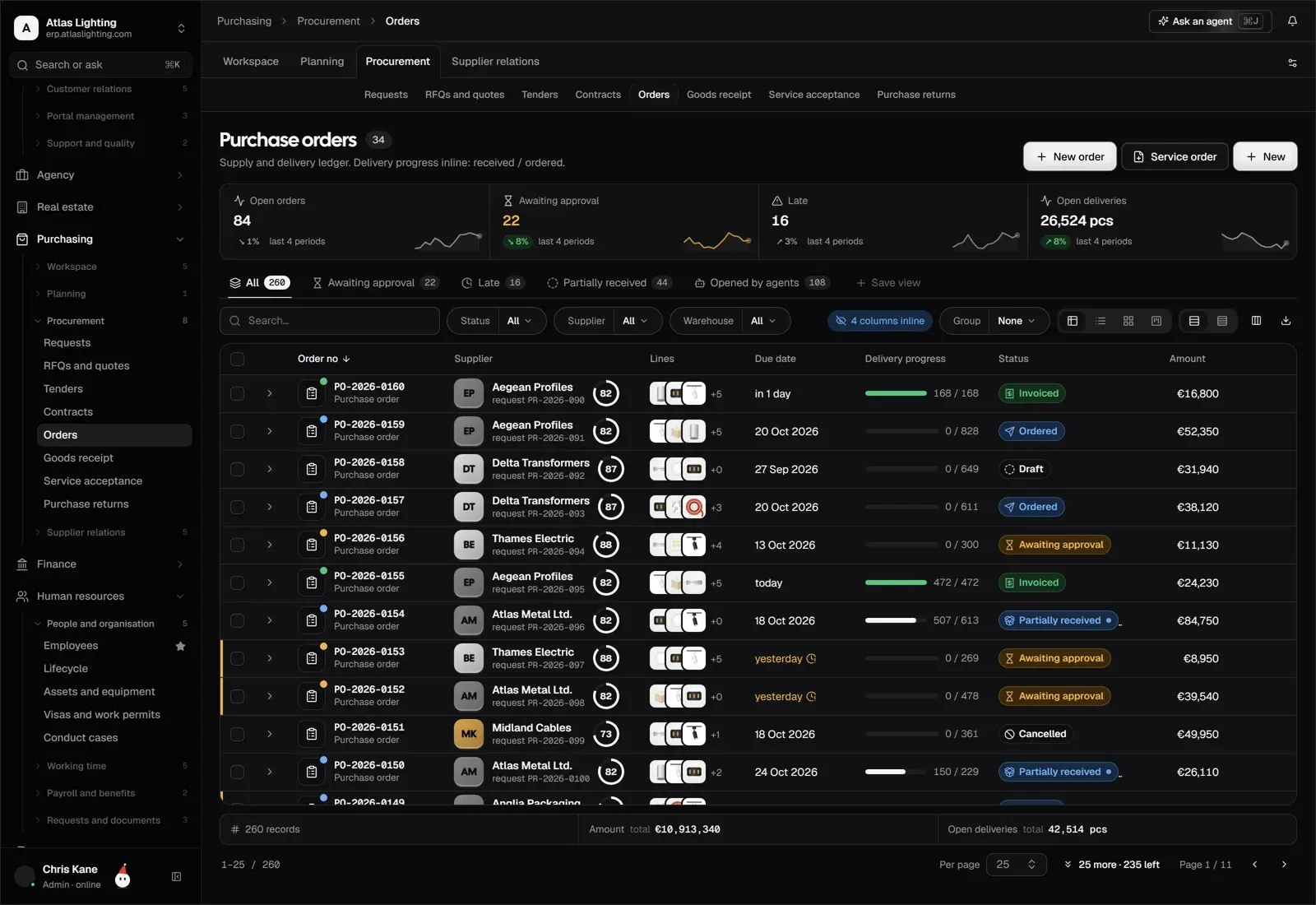
Purchase orders with approvals in Dika Ops
Built the same way · purchasing in Dika Ops
04 · Capabilities

Sixteen capabilities. One accountable team.

Everything we design, build and run in Custom software, delivered by the same senior team.

  • 01

    Enterprise web applications

    Browser-based systems for complex rules, roles and data, built for daily use by many teams.

  • 02

    Customer and partner portals

    Self-service access to orders, documents, requests and account history.

  • 03

    Internal operations platforms

    One place for the processes that live today in spreadsheets, email and chat.

  • 04

    Workflow automation

    Routing, reminders, escalations and status changes handled by the system, not by people.

  • 05

    API and system integrations

    Reliable connections to CRM, ERP, finance, identity and the tools you already run.

  • 06

    Legacy system modernisation

    Gradual replacement of ageing systems without stopping the business.

  • 07

    Role-based access control

    Permissions by role, team and record, with data scope enforced on the server.

  • 08

    Data migration

    Mapped, cleaned and verified transfer of records from old systems and files.

  • 09

    Multi-tenant architecture

    One platform serving several companies, brands or regions with separated data.

  • 10

    Document and approval workflows

    Requests, approvals and signed documents with a full history of decisions.

  • 11

    Admin and back-office systems

    Settings, master data and controls for the people who run the system.

  • 12

    Reporting and dashboards

    Operational views and exports built on the same records the work happens in.

  • 13

    Quality assurance

    Automated and manual testing planned with each feature, not after it.

  • 14

    Observability and error tracking

    Logs, errors and performance signals that show problems before users report them.

  • 15

    Performance engineering

    Fast screens and queries under real data volumes and many concurrent users.

  • 16

    Continuous development

    Regular releases after launch, prioritised together with your team.

05 · How an engagement runs

Five steps, visible at every stage.

  1. 01DiscoveryWorkshops with the people who do the work: process maps, constraints and success measures.
  2. 02ArchitectureData model, integrations, security and a staged roadmap agreed before the build starts.
  3. 03DesignInterface prototypes tested with real users and realistic data.
  4. 04Build and releaseShort increments in a staging environment, released to production when they are ready.
  5. 05Adoption and supportTraining, documentation, monitoring and continued development.
06 · What you receive

Deliverables you keep, not just a launch.

Every engagement ends with assets your organisation owns and can run without us.

Plan the first phase
  • Process and requirements map

    Documented workflows, roles, business rules and acceptance criteria.

  • System architecture

    Data model, integration design and security approach, in writing.

  • Working software

    Production releases, with source-code access defined in the agreement.

  • Automated tests

    Coverage for business rules and the paths the operation depends on.

  • Documentation and handover

    Admin guides, runbooks and technical documentation your team can use.

  • Support plan

    Monitoring, response routes and a backlog for what comes next.

07 · Who it is for

Built for organisations like yours.

Operations-heavy companies

Manufacturing, wholesale, logistics and service businesses with complex daily work.

Growing mid-size businesses

Teams that have outgrown spreadsheets and starter tools.

Organisations with legacy systems

Businesses that depend on an ageing system that has to keep running.

Product and platform teams

Companies building software for their own customers or partners.

When does custom software make sense?

Custom software is worth building when a process gives you an advantage, when standard products need so many workarounds that people stop trusting them, or when several disconnected tools have to behave as one system.

If a packaged product covers most of what you need, we will say so. Often the right answer is a packaged core with a small custom layer: a portal, an integration or an approval flow built around it.

Custom build or packaged product?

Packaged products are quick to start and cheap at first, but they follow someone else's process. A custom application follows yours, and it can grow with new rules, markets and integrations without licence-per-feature costs.

We compare both paths on total cost over several years, the effort of the workarounds you run today, and how much control you need over data, hosting and the roadmap.

What shapes cost and timeline?

The main drivers are the number of roles and workflows, how many systems the application must connect to, the state of the data that has to move across, and the security and audit requirements.

We reduce risk by starting with discovery and architecture, then delivering in increments. You see working software early, and each release is useful on its own instead of waiting for one large launch.

How we keep the system yours

Ownership, licensing and source-code access are set out in the agreement. We document decisions, keep the architecture understandable and can deploy to infrastructure you control, so the system does not depend on us forever.

FAQ

Custom software, answered.

Clear answers before discovery, scoping and delivery begin.

Ask a different question
When is custom software the right choice?

Custom software is appropriate when the process creates competitive value, standard tools require excessive workarounds, or several disconnected systems need to operate as one.

Can you integrate with our existing systems?

Yes. We design API, database and workflow integrations around the systems you already use, including CRM, ERP, commerce, identity and internal platforms.

Who owns the software and source code?

Ownership and licensing are defined clearly in the project agreement. Client-specific systems can be delivered with source-code access and documentation.

Can the application run on our infrastructure?

Yes. Where required, we can design and deploy the application for customer-controlled cloud or server infrastructure.

How do you approach security?

We apply least-privilege access, server-side secret handling, validation, auditability and secure delivery practices appropriate to the system's risk profile.

How long does a custom software project take?

Timing depends on scope and integration depth. We normally begin with discovery, define a staged roadmap, and deliver useful increments instead of waiting for one large release.

Do you support the system after launch?

Yes. We provide maintenance, monitoring, performance work, new feature development and managed product engineering.

Can you work with our in-house developers?

Yes. We can lead the work, share it with your developers, or support your team on a defined part of the system, with agreed code standards and reviews.

Do you sign a non-disclosure agreement?

Yes. We are happy to sign an NDA before discovery, and confidentiality terms are also part of the project agreement.

What do you need from us to start?

Access to the people who do the work, examples of the documents and data involved, and someone who can make decisions on priorities.

Build software your teams can depend on.

Bring us the workflow, bottleneck or platform problem. We will turn it into a clear technical roadmap and a system your organisation can operate.

  • Discovery and architecture before commitment
  • Incremental delivery with visible progress
  • Ongoing engineering available after launch