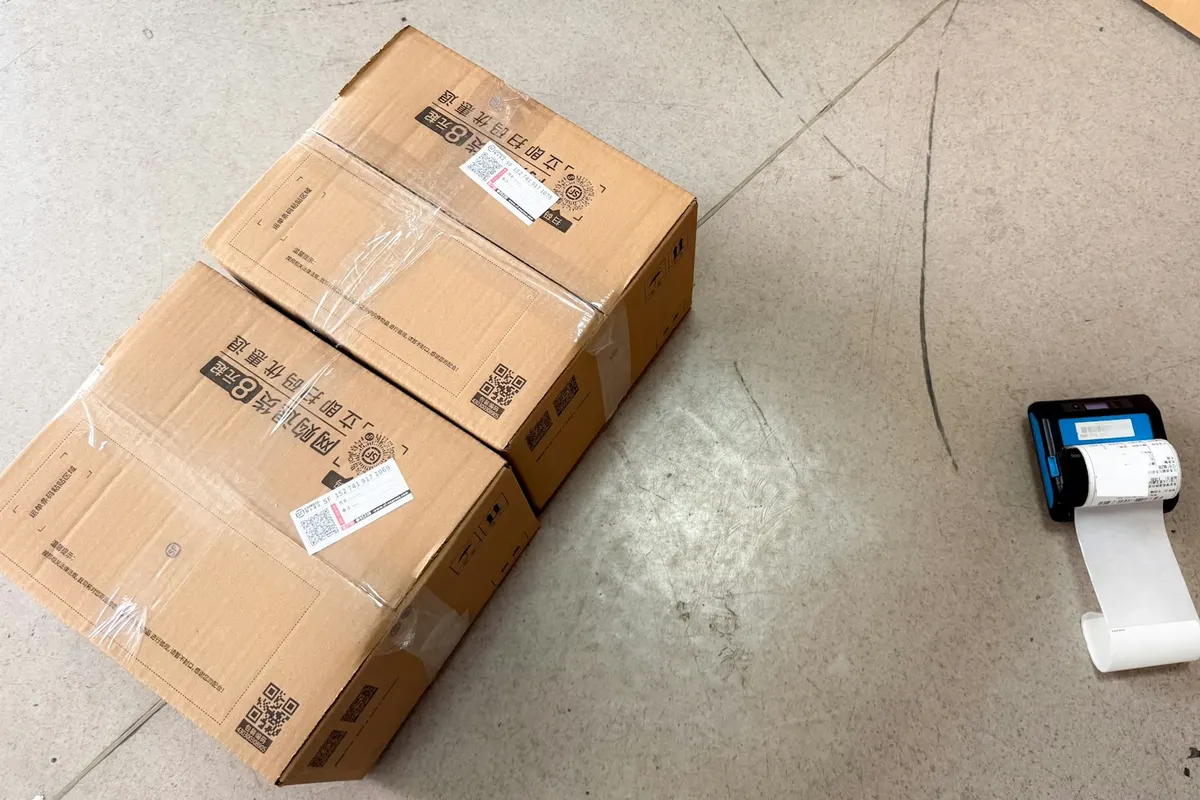
To calculate the volumetric weight of a box, multiply its outside length, width and height to get the volume, then divide that volume by the divisor your carrier uses. With a common divisor of 5,000 cm³ per kilogram, a box measuring 60 × 40 × 30 cm has a volumetric weight of 14.4 kg. You are usually charged on whichever is higher, the volumetric weight or the actual weight on the scale, so the calculation decides the cost of many parcels.
You can do the sum on paper, or use our shipping cost calculator with volumetric weight, which follows the same steps and shows the working for each package. This guide explains the formula, the units that cause most errors, how to choose the divisor, and how to measure a box so that the result is reliable.
Why volumetric weight exists
A delivery vehicle or aircraft has limited space as well as limited weight. A large box filled with light packing takes up room that could carry heavier, denser parcels, so carriers charge for the space a parcel occupies. Volumetric weight, sometimes called dimensional weight, converts that volume into a weight figure so that bulky and heavy parcels can be compared on one scale.
The effect is easy to miss. A pillow, a lamp shade or a flat-pack chair in a large box can cost more to send than a small, heavy tool, even though the tool weighs far more. Sellers who only look at the scale can be surprised by their shipping bills for this reason. If your team also plans storage space, the warehouse management system guide explains how stock locations and packing fit together.
Step 1: measure the box from the outside
Measure the outside of the box, because the carrier handles the outside. Use a tape measure, round up to the nearest whole centimetre, and record the three dimensions in the same order every time.
- Lay the closed box flat and measure its longest side. This is the length.
- Measure the side at right angles to the length. This is the width.
- Measure from the base to the top of the closed box. This is the height.
- Write the numbers down with their unit, for example 60 cm × 40 cm × 30 cm.
Soft, bulging or irregular parcels should be measured at their fullest point. The method matters more than perfection, because you will compare results over time and need every box treated the same way.
Step 2: multiply to get the volume
Multiply length by width by height. In the example, 60 × 40 × 30 gives 72,000 cubic centimetres. Keep the unit consistent, with centimetres in and cubic centimetres out. Mixing centimetres and inches is the most common reason for a result that is wildly wrong.

Step 3: divide by the divisor your carrier states
Divide the volume by the divisor. The divisor is a conversion factor that the carrier sets for each service, and it is written in that carrier's terms. The figures below are the common divisors our calculator lists, so they help you check a quote, but the figure in your own terms is the one that applies.
| Divisor | Unit system | When you see it | Result for the 72,000 cm³ box |
|---|---|---|---|
| 5,000 | cm³ per kg | A frequently quoted metric divisor | 14.4 kg |
| 6,000 | cm³ per kg | Another common metric divisor | 12.0 kg |
| 4,000 | cm³ per kg | A lower divisor that makes parcels look heavier | 18.0 kg |
| 139 | in³ per lb | The common imperial divisor | About 31.6 lb when the same box is entered in inches |
A smaller divisor produces a higher volumetric weight, so the same box can cost more with one service than with another. Confirm the divisor for the exact service you use before you compare quotes, and never assume that a figure from one carrier applies to another.
Step 4: compare with the actual weight
Weigh the packed box, including padding, tape and the label, on a scale you trust. If you already run regular counts, the stock count guide shows how to keep measurements consistent. Then compare the actual weight with the volumetric weight. The chargeable weight is the higher of the two, and that is the figure the carrier uses to bill the parcel.
The table below shows how this works for three packing options for the same product, with a packed weight of 5 kg and a divisor of 5,000. The largest box is charged on its volume, while the smallest box is charged on its real weight.
| Option | Outside size (cm) | Volume (cm³) | Volumetric weight | Actual weight | Chargeable weight |
|---|---|---|---|---|---|
| Box A | 60 × 40 × 30 | 72,000 | 14.4 kg | 5.0 kg | 14.4 kg, volume drives the charge |
| Box B | 40 × 30 × 25 | 30,000 | 6.0 kg | 5.0 kg | 6.0 kg, volume drives the charge |
| Box C | 35 × 25 × 20 | 17,500 | 3.5 kg | 5.0 kg | 5.0 kg, weight drives the charge |
This is why a box that is only slightly too big can add to a shipping bill, and why a box that fits the product closely can lower it. Test two or three box sizes before you buy packaging in bulk.
Step 5: apply rounding if your carrier rounds up
Some services round chargeable weight up to the next 0.5 kg or the next whole kilogram. Rounding changes the chargeable weight, so check the rule in your terms. If the carrier does not round, leave rounding off, because an extra step adds cost you do not need to pay.
Our calculator offers rounding steps of 0.1, 0.5 and 1 and applies them to each package separately. Use the step that matches your terms and compare the chargeable weight with and without rounding.
Common mistakes to avoid
- Measuring the product instead of the packed box. The carrier bills the parcel as it travels.
- Using only the actual weight. A light but bulky parcel can cost more than a heavy, compact one.
- Entering inches into a centimetre divisor, or the reverse.
- Copying a divisor from an old quote without checking the current service terms.
- Forgetting that the outside of the box grows with the padding inside it.
If you ship many parcels, a bulk-shipment check can use the same logic. Our pallet capacity calculator helps you see how many boxes fit on a pallet before you work out the freight.
Working through an order from start to finish
Suppose a shop sends one parcel of home textiles. The owner measures the box at 60 × 40 × 30 cm, weighs the packed parcel at 5 kg and uses a divisor of 5,000 from the service terms. The volume is 72,000 cm³, the volumetric weight is 14.4 kg, and the chargeable weight is therefore 14.4 kg, even though the scale shows 5 kg. The owner then tests a smaller box and finds that a 40 × 30 × 25 cm box brings the chargeable weight down to 6.0 kg.
The example uses the assumptions stated above. Your own figures will differ, so repeat the same steps with your real boxes and your real divisor.
How to run the calculation in our calculator
- Open the shipping cost calculator and choose centimetres or inches for the dimensions.
- Choose kilograms or pounds for the weight.
- Select a common divisor such as 5000 cm³/kg, or choose Custom and type the divisor in your terms.
- Enter length, width, height and weight for each package, and add a row for each package type.
- Select a rounding step if your carrier rounds up, or leave it on no rounding.
- Read the volumetric weight, actual weight and chargeable weight, and open the breakdown to see which figure drives the charge.
To share a calculation, open the calculator with a link that fills in the values, for example a 60 × 40 × 30 cm parcel of 5 kg, two units, divisor 5,000.
Next step
Volumetric weight is one calculation: the volume divided by the right divisor, compared with the actual weight. Measure the packed box, take the divisor from your service terms, and keep your units consistent. For a wider view of orders, stock and logistics on one record, see the logistics module in Dika Ops. If you want to see how shipping rules fit your online shop, our commerce work covers that, and you can talk to us about your case. Our team at Dika Design replies with a clear next step.
Frequently asked questions
What is the volumetric weight formula?
Volumetric weight equals length multiplied by width multiplied by height, divided by the divisor. For a 60 × 40 × 30 cm box and a divisor of 5,000 cm³ per kg, the result is 14.4 kg. Use the divisor stated in your carrier's terms.
Is volumetric weight the same as dimensional weight?
In everyday use, yes. Both terms describe a weight figure calculated from the size of the parcel. Quote sheets use one name or the other, so look for the formula and the divisor in the terms rather than relying on the label.
Is the carrier charge based on the higher of actual and volumetric weight?
Usually, yes. Many services bill on the chargeable weight, which is the higher of the two figures for each parcel. If a service bills in a different way, its terms set out the rule, and that rule applies instead.
Should I measure the box or the product inside it?
Measure the box from the outside, because that is the space the parcel takes up in transit. Weigh the packed parcel too, including padding and labels. Measuring only the product understates the volumetric weight.
What if the parcel does not have a regular shape?
Measure the longest length, the widest width and the tallest height of the parcel as it will travel. Measure soft or irregular parcels at their fullest point. Record the method once and use it for every parcel, so that your comparisons stay fair.
Summary
To calculate the volumetric weight of a box, multiply its outside dimensions, divide by the divisor in your terms, and compare the result with the actual weight. The higher figure is the chargeable weight in most cases. Measure real boxes, keep the units consistent and check the rounding rule before you rely on the answer.